Not Having a Period for a Year and Then It Starts Again
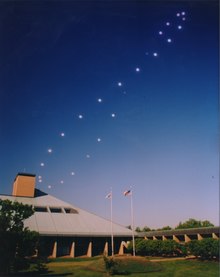
A year or annum is the orbital period of a planetary body, for case, the Earth, moving in its orbit around the Sunday. Due to the Earth's centric tilt, the course of a year sees the passing of the seasons, marked by change in weather condition, the hours of daylight, and, consequently, vegetation and soil fertility. In temperate and subpolar regions around the planet, 4 seasons are more often than not recognized: bound, summer, autumn and winter. In tropical and subtropical regions, several geographical sectors do not present defined seasons; simply in the seasonal tropics, the almanac wet and dry seasons are recognized and tracked.
A calendar year is an approximation of the number of days of the Earth's orbital period, every bit counted in a given calendar. The Gregorian agenda, or modern calendar, presents its calendar year to be either a common yr of 365 days or a leap yr of 366 days, as practice the Julian calendars . For the Gregorian calendar, the boilerplate length of the agenda yr (the mean year) across the complete leap cycle of 400 years is 365.2425 days. In English, the abbreviations "y" and "yr" are unremarkably used ("a" is too used) for the unit of time, though its verbal duration may be inconsistent.
In astronomy, the Julian twelvemonth is a unit of time; it is divers every bit 365.25 days of exactly 86,400 seconds (SI base unit), totalling exactly 31,557,600 seconds in the Julian astronomical year.[ane]
The word yr is also used for periods loosely associated with, merely not identical to, the agenda or astronomical yr, such as the seasonal twelvemonth, the fiscal year, the academic twelvemonth, etc. Similarly, yr tin hateful the orbital menses of whatsoever planet; for example, a Martian year and a Venusian twelvemonth are examples of the time a planet takes to transit ane consummate orbit. The term can too exist used in reference to any long period or cycle, such equally the Great Year.[2]
Etymology
English twelvemonth (via West Saxon ġēar (/jɛar/), Anglian ġēr) continues Proto-Germanic *jǣran (*jē₁ran). Cognates are German Jahr, Onetime High High german jār, Sometime Norse ár and Gothic jer, from the Proto-Indo-European noun *yeh₁r-om "twelvemonth, flavor". Cognates also descended from the same Proto-Indo-European noun (with variation in suffix ablaut) are Avestan yārǝ "year", Greek ὥρα ( hṓra ) "twelvemonth, flavour, menstruum of time" (whence "hr"), Old Church Slavonic jarŭ, and Latin hornus "of this year".
Latin annus (a 2nd declension masculine noun; annum is the accusative singular; annī is genitive singular and nominative plural; annō the dative and ablative atypical) is from a PIE noun *h₂et-no- , which also yielded Gothic aþn "year" (only the dative plural aþnam is attested).
Although most languages treat the word as thematic *yeh₁r-o-, there is evidence for an original derivation with an *-r/n suffix, *yeh₁-ro-. Both Indo-European words for year, *yeh₁-ro- and *h₂et-no-, would then be derived from verbal roots pregnant "to go, move", *h₁ey- and *h₂et-, respectively (compare Vedic Sanskrit éti "goes", atasi "thou goest, wanderest"). A number of English words are derived from Latin annus , such as almanac, annuity, anniversary, etc.; per annum means "each twelvemonth", annō Dominī means "in the yr of the Lord".
The Greek word for "year", ἔτος , is cognate with Latin vetus "old", from the PIE give-and-take *wetos- "yr", also preserved in this meaning in Sanskrit vat-sa-ras "year" and vat-sa- "yearling (calf)", the latter also reflected in Latin vitulus "bull dogie", English language wether "ram" (Old English weðer, Gothic wiþrus "lamb").
In some languages, it is common to count years by referencing to one season, as in "summers", or "winters", or "harvests". Examples include Chinese 年 "twelvemonth", originally 秂, an ideographic chemical compound of a person carrying a package of wheat denoting "harvest". Slavic besides godŭ "time menstruation; twelvemonth" uses lěto "summer; year".
Intercalation
Astronomical years do not have an integer number of days or lunar months. Any agenda that follows an astronomical yr must have a system of intercalation such as jump years.
Julian calendar
In the Julian agenda, the boilerplate (mean) length of a twelvemonth is 365.25 days. In a not-leap year, there are 365 days, in a leap yr there are 366 days. A leap twelvemonth occurs every fourth year, or leap year, during which a leap mean solar day is intercalated into the month of February. The proper noun "Leap Day" is applied to the added mean solar day.
The Revised Julian agenda, proposed in 1923 and used in some Eastern Orthodox Churches, has 218 leap years every 900 years, for the boilerplate (mean) year length of 365.2422222 days, close to the length of the mean tropical twelvemonth, 365.242nineteen days (relative mistake of 9·10−8). In the year 2800 CE, the Gregorian and Revised Julian calendars will begin to differ past one calendar day.[3]
Gregorian agenda
The Gregorian calendar attempts to crusade the due north equinox to fall on or soon earlier March 21 and hence information technology follows the northward equinox twelvemonth, or tropical twelvemonth.[4] Because 97 out of 400 years are bound years, the mean length of the Gregorian calendar twelvemonth is 365.2425 days; with a relative error below one ppm (viii·x−vii) relative to the electric current length of the mean tropical yr (365.242xix days) and even closer to the current March equinox year of 365.242374 days that it aims to match. It is estimated that by the year 4000 CE, the northward equinox volition fall back by ane mean solar day in the Gregorian calendar, not because of this difference, but due to the slowing of the Earth's rotation and the associated lengthening of the solar day.
Other calendars
Historically, lunisolar calendars intercalated unabridged bound months on an observational basis. Lunisolar calendars accept mostly fallen out of use except for liturgical reasons (Hebrew calendar, various Hindu calendars).
A modern accommodation of the historical Jalali agenda, known as the Solar Hijri calendar (1925), is a purely solar calendar with an irregular pattern of spring days based on observation (or astronomical computation), aiming to place new yr (Nowruz) on the day of vernal equinox (for the time zone of Tehran), every bit opposed to using an algorithmic organisation of leap years.
Twelvemonth numbering
A calendar era assigns a fundamental number to each sequential year, using a reference event in the past (called the epoch) as the kickoff of the era.
The Gregorian agenda era is the globe'southward most widely used civil calendar.[5] Its epoch is a 6th century estimate of the appointment birth of Jesus of Nazareth. Two notations are used to indicate year numbering in the Gregorian calendar: the Christian "Anno Domini" (meaning "in the twelvemonth of the Lord"), abbreviated Advertising; and "Common Era", abbreviated CE, preferred by many of other faiths and none. Twelvemonth numbers are based on inclusive counting, so that there is no "year nada". Years before the epoch are abbreviated BC for Before Christ or BCE for Before the Common Era. In Astronomical year numbering, positive numbers signal years AD/CE, the number 0 designates i BC/BCE, −1 designates 2 BC/BCE, then on.
Other eras include that of Aboriginal Rome, Ab Urbe Condita ("from the foundation of the urban center), abbreviated AUC; Anno Mundi ("twelvemonth of the globe"), used for the Hebrew calendar and abbreviated AM; and the Japanese emperor eras described above. (The Islamic Anno Hegirae (yr of the Hegira), abbreviated AH, is a lunar calendar of twelve lunar months and thus is shorter than a solar yr.)
Pragmatic divisions
Financial and scientific calculations often employ a 365-day agenda to simplify daily rates.
Fiscal year
A fiscal yr or financial year is a 12-month period used for computing annual financial statements in businesses and other organizations. In many jurisdictions, regulations regarding accounting require such reports one time per twelve months, merely do non require that the twelve months constitute a agenda twelvemonth.
For example, in Canada and India the fiscal year runs from April 1; in the United Kingdom information technology runs from April 1 for purposes of corporation tax and authorities financial statements, but from April 6 for purposes of personal tax and payment of country benefits; in Australia it runs from July 1; while in the United states of america the fiscal year of the federal government runs from October i.
Academic yr
An academic year is the almanac flow during which a student attends an educational institution. The academic year may be divided into academic terms, such equally semesters or quarters. The school year in many countries starts in August or September and ends in May, June or July. In Israel the academic yr begins effectually Oct or November, aligned with the second calendar month of the Hebrew agenda.
Some schools in the UK, Canada and the The states divide the academic twelvemonth into 3 roughly equal-length terms (called trimesters or quarters in the Us), roughly coinciding with autumn, winter, and spring. At some, a shortened summertime session, sometimes considered part of the regular academic year, is attended by students on a voluntary or elective ground. Other schools interruption the yr into two main semesters, a first (typically August through December) and a second semester (Jan through May). Each of these main semesters may exist split in half past mid-term exams, and each of the halves is referred to as a quarter (or term in some countries). There may too be a voluntary summertime session and/or a short January session.
Some other schools, including some in the U.s.a., have 4 marking periods. Some schools in the United States, notably Boston Latin School, may dissever the year into five or more marking periods. Some country in defense of this that there is maybe a positive correlation between report frequency and academic achievement.
At that place are typically 180 days of pedagogy each year in schools in the U.s.a., excluding weekends and breaks, while in that location are 190 days for pupils in state schools in Canada, New Zealand and the United kingdom of great britain and northern ireland, and 200 for pupils in Australia.
In India the academic year normally starts from June 1 and ends on May 31. Though schools start closing from mid-March, the actual academic closure is on May 31 and in Nepal it starts from July 15.[ citation needed ]
Schools and universities in Australia typically accept academic years that roughly align with the agenda year (i.e., starting in February or March and ending in October to December), every bit the southern hemisphere experiences summer from December to Feb.
Astronomical years
Julian year
The Julian twelvemonth, as used in astronomy and other sciences, is a time unit of measurement defined as exactly 365.25 days. This is the normal meaning of the unit "year" used in various scientific contexts. The Julian century of 36525 days and the Julian millennium of 365250 days are used in astronomical calculations. Fundamentally, expressing a time interval in Julian years is a way to precisely specify how many days (not how many "real" years), for long time intervals where stating the number of days would be unwieldy and unintuitive. By convention, the Julian twelvemonth is used in the ciphering of the distance covered by a light-twelvemonth.
In the Unified Code for Units of Measure, the symbol a (without subscript) always refers to the Julian yr, aj , of exactly 31557 600 seconds.
- 365.25 d × 86400 s = ane a = one aj = 31.5576 Ms
The SI multiplier prefixes may be applied to it to form "ka" (kiloannus), "Ma" (megaannus), etc.[ commendation needed ]
Sidereal, tropical, and anomalistic years
Each of these three years can exist loosely called an astronomical yr.
The sidereal year is the time taken for the Earth to consummate i revolution of its orbit, as measured confronting a fixed frame of reference (such every bit the stock-still stars, Latin sidera , singular sidus ). Its average duration is 365.256363 004 days (365 d six h 9 min 9.76 due south) (at the epoch J2000.0 = January one, 2000, 12:00:00 TT).[6]
Today the mean tropical year is defined as the flow of time for the mean ecliptic longitude of the Dominicus to increase by 360 degrees.[7] Since the Sun'due south ecliptic longitude is measured with respect to the equinox,[8] the tropical year comprises a consummate cycle of the seasons and is the basis of solar calendars such as the internationally used Gregorian agenda. The modernistic definition of mean tropical twelvemonth differs from the actual fourth dimension between passages of, eastward.g., the northward equinox for several reasons explained below. Considering of the Earth's centric precession, this year is virtually 20 minutes shorter than the sidereal yr. The mean tropical yr is approximately 365 days, 5 hours, 48 minutes, 45 seconds, using the modern definition[nine] ( = 365.24219 d × 86 400 s).
The anomalistic year is the time taken for the World to complete 1 revolution with respect to its apsides. The orbit of the World is elliptical; the extreme points, called apsides, are the perihelion, where the Earth is closest to the Sun (January 5, 07:48 UT in 2020), and the aphelion, where the Earth is farthest from the Sun (July 4, 11:35 UT in 2020). The anomalistic year is usually defined as the time between perihelion passages. Its average elapsing is 365.259636 days (365 d 6 h 13 min 52.half-dozen s) (at the epoch J2011.0).[10]
Draconic year
The draconic year, draconitic year, eclipse year, or ecliptic year is the fourth dimension taken for the Sun (as seen from the Earth) to consummate one revolution with respect to the same lunar node (a betoken where the Moon's orbit intersects the ecliptic). The year is associated with eclipses: these occur only when both the Sunday and the Moon are near these nodes; so eclipses occur within virtually a month of every half eclipse year. Hence at that place are two eclipse seasons every eclipse year. The average duration of the eclipse year is
- 346.620075 883 days (346 d 14 h 52 min 54 s) (at the epoch J2000.0).
This term is sometimes erroneously used for the draconic or nodal period of lunar precession, that is the period of a complete revolution of the Moon's ascending node around the ecliptic: 18.612815 932 Julian years ( 6798.331019 days; at the epoch J2000.0).
Full moon cycle
The full moon cycle is the time for the Sun (as seen from the Earth) to complete one revolution with respect to the perigee of the Moon's orbit. This period is associated with the apparent size of the total moon, and also with the varying elapsing of the synodic month. The duration of one full moon cycle is:
- 411.784430 29 days (411 days 18 hours 49 minutes 35 seconds) (at the epoch J2000.0).
Lunar year
The lunar year comprises twelve full cycles of the phases of the Moon, as seen from Earth. It has a duration of approximately 354.37 days. Muslims use this for jubilant their Eids and for marking the start of the fasting calendar month of Ramadan. A Muslim calendar yr is based on the lunar cycle. The Jewish calendar is too essentially lunar, except that an intercalary lunar month is added one time every two or 3 years, in guild to keep the calendar synchronized with the solar bicycle also. Thus, a lunar year on the Jewish (Hebrew) agenda consists of either twelve or thirteen lunar months.
Vague year
The vague year, from annus vagus or wandering year, is an integral approximation to the twelvemonth equaling 365 days, which wanders in relation to more exact years. Typically the vague year is divided into 12 schematic months of xxx days each plus 5 epagomenal days. The vague year was used in the calendars of Ethiopia, Ancient Egypt, Islamic republic of iran, Armenia and in Mesoamerica among the Aztecs and Maya.[11] It is still used by many Zoroastrian communities.
Heliacal year
A heliacal year is the interval between the heliacal risings of a star. Information technology differs from the sidereal twelvemonth for stars away from the ecliptic due mainly to the precession of the equinoxes.
Sothic year
The Sothic twelvemonth is the interval betwixt heliacal risings of the star Sirius. Information technology is currently less than the sidereal year and its elapsing is very shut to the Julian year of 365.25 days.
Gaussian year
The Gaussian year is the sidereal yr for a planet of negligible mass (relative to the Lord's day) and unperturbed past other planets that is governed by the Gaussian gravitational constant. Such a planet would exist slightly closer to the Sun than Earth'southward mean altitude. Its length is:
- 365.2568983 days (365 d 6 h 9 min 56 s).
Besselian year
The Besselian year is a tropical year that starts when the (fictitious) mean Sun reaches an ecliptic longitude of 280°. This is currently on or close to January 1. Information technology is named after the 19th-century German astronomer and mathematician Friedrich Bessel. The post-obit equation tin can be used to compute the electric current Besselian epoch (in years):[12]
- B = 1900.0 + (Julian dateTT − 2415 020.31352 ) / 365.242198 781
The TT subscript indicates that for this formula, the Julian appointment should use the Terrestrial Fourth dimension scale, or its predecessor, ephemeris fourth dimension.
Variation in the length of the year and the mean solar day
The exact length of an astronomical year changes over time.
- The positions of the equinox and solstice points with respect to the apsides of Earth's orbit change: the equinoxes and solstices movement w relative to the stars considering of precession, and the apsides move in the other management because of the long-term furnishings of gravitational pull by the other planets. Since the speed of the World varies according to its position in its orbit equally measured from its perihelion, World's speed when in a solstice or equinox bespeak changes over time: if such a point moves toward perihelion, the interval between two passages decreases a trivial from yr to year; if the point moves towards aphelion, that period increases a little from year to year. Then a "tropical year" measured from one passage of the northward ("vernal") equinox to the next, differs from the one measured between passages of the southward ("autumnal") equinox. The average over the full orbit does not alter because of this, and so the length of the average tropical year does not change because of this 2nd-order effect.
- Each planet's motion is perturbed past the gravity of every other planet. This leads to curt-term fluctuations in its speed, and therefore its period from year to year. Moreover, it causes long-term changes in its orbit, and therefore also long-term changes in these periods.
- Tidal drag between the Earth and the Moon and Sun increases the length of the day and of the month (by transferring angular momentum from the rotation of the Earth to the revolution of the Moon); since the apparent mean solar 24-hour interval is the unit of measurement with which we measure the length of the twelvemonth in civil life, the length of the year appears to subtract. The rotation rate of the Earth is also changed by factors such equally post-glacial rebound and sea level rise.
- Numerical value of year variation
Hateful year lengths in this department are calculated for 2000, and differences in year lengths, compared to 2000, are given for past and future years. In the tables a day is 86,400 SI seconds long.[13] [14] [fifteen] [xvi]
| Type of twelvemonth | Days | Hours | Minutes | Seconds |
|---|---|---|---|---|
| Tropical | 365 | 5 | 48 | 45 |
| Sidereal | 365 | vi | nine | 10 |
| Anomalistic | 365 | 6 | 13 | 53 |
| Eclipse | 346 | 14 | 52 | 55 |
| Year | Tropical | Sidereal | Anomalistic | Eclipse |
|---|---|---|---|---|
| −4000 | −8 | −45 | −15 | −174 |
| −2000 | 4 | −19 | −11 | −116 |
| 0 | 7 | −four | −5 | −57 |
| 2000 | 0 | 0 | 0 | 0 |
| 4000 | −14 | −3 | five | 54 |
| 6000 | −35 | −12 | 10 | 104 |
Summary
| Days | Year type |
|---|---|
| 346.62 | Draconic, also chosen eclipse. |
| 354.37 | Lunar. |
| 365 | Vague, and a common yr in many solar calendars. |
| 365.24219 | Tropical, likewise called solar, averaged and so rounded for epoch J2000.0. |
| 365.2425 | Gregorian, on average. |
| 365.25 | Julian. |
| 365.25636 | Sidereal, for epoch J2000.0. |
| 365.259636 | Anomalistic, averaged and then rounded for epoch J2011.0. |
| 366 | Leap in many solar calendars. |
An boilerplate Gregorian twelvemonth is 365.2425 days (52.1775 weeks, viii765.82 hours, 525949.ii minutes or 31556 952 seconds). For this calendar, a mutual year is 365 days ( 8760 hours, 525600 minutes or 31536 000 seconds), and a leap year is 366 days ( 8784 hours, 527040 minutes or 31622 400 seconds). The 400-year wheel of the Gregorian calendar has 146097 days and hence exactly 20871 weeks.
Greater astronomical years
Equinoctial cycle
The Not bad Twelvemonth, or equinoctial bike, corresponds to a complete revolution of the equinoxes around the ecliptic. Its length is about 25,700 years.
Galactic twelvemonth
The Galactic year is the time it takes Globe'southward Solar Organisation to revolve in one case effectually the galactic eye. Information technology comprises roughly 230 one thousand thousand Earth years.[17]
Seasonal twelvemonth
A seasonal year is the time between successive recurrences of a seasonal outcome such every bit the flooding of a river, the migration of a species of bird, the flowering of a species of plant, the starting time frost, or the first scheduled game of a certain sport. All of these events tin can have wide variations of more than a month from year to twelvemonth.
Symbols
A mutual symbol for the year as a unit of time is "a", taken from the Latin word annus . In English language, the abbreviations "y" or "yr" are more commonly used in non-scientific literature just as well specifically in geology and paleontology, where "kyr, myr, byr" (thousands, millions, and billions of years, respectively) and similar abbreviations are used to denote intervals of time remote from the present.[18] [19] [20]
Symbol
NIST SP811[21] supports the symbol "a" every bit the unit of fourth dimension for a year. In English language, the abbreviations "y" and "yr" are also used.[18] [19] [20]
The Unified Code for Units of Measure[22] disambiguates the varying symbologies of ISO g, ISO 2955 and ANSI X3.50[23] by using:
- at = 365.24219 days for the mean tropical year;
- aj = 365.25 days for the mean Julian year;
- agrand = 365.2425 days for the mean Gregorian year;
where:
- a, without a qualifier = 1 aj;
- and ar, for are, is a unit of expanse.
The International Union of Pure and Applied Chemistry (IUPAC) and the International Union of Geological Sciences have jointly recommended defining the "annus", with symbol "a", as the length of the tropical year in the year 2000:
- a = 31556 925.445 seconds (approximately 365.242192 65 ephemeris days)
This differs from the above definition of 365.25 days by about 20 parts per million. The joint document says that definitions such as the Julian year "bear an inherent, pre-programmed obsolescence because of the variability of Earth's orbital movement", but so proposes using the length of the tropical year as of 2000 AD (specified down to the millisecond), which suffers from the same trouble.[24] [25] (The tropical yr oscillates with time by more than than a minute.)
The notation has proved controversial as it conflicts with an earlier convention among geoscientists to utilize "a" specifically for years ago, and "y" or "year" for a one-yr fourth dimension menstruum.[25]
SI prefix multipliers
For the post-obit, there are alternative forms that elide the consecutive vowels, such as kilannum, megannum, etc. The exponents and exponential notations are typically used for computing and in displaying calculations, and for conserving space, equally in tables of data.
- ka (for kiloannum) – a unit of time equal to one thousand, or teniii, years, or 1 E3 yr, besides known equally a millennium in anthropology and calendar uses. The prefix multiplier "ka" is typically used in geology, paleontology, and archaeology for the Holocene and Pleistocene periods, where a non−radiocarbon dating technique: due east.chiliad. ice cadre dating, tree-ring dating, uranium-thorium dating, or varve assay; is used as the principal dating method for age determination. If age is determined primarily by radiocarbon dating, then the historic period should be expressed in either radiocarbon or calendar (calibrated) years Before Present.
- Ma (for megaannum) – a unit of fourth dimension equal to 1 million, or ten6, years, or one E6 year. The suffix "Ma" is ordinarily used in scientific disciplines such as geology, paleontology, and celestial mechanics to signify very long time periods into the by or futurity. For example, the dinosaur species Tyrannosaurus rex was arable approximately 66 Ma (66 million years) ago. The duration term "ago" may not always be indicated: if the quantity of a elapsing is specified while non explicitly mentioning a duration term, i tin can presume that "ago" is unsaid; the alternative unit of measurement "mya" does include "ago" explicitly. It is also written as "million years" (ago) in works for general public employ. In astronomical applications, the yr used is the Julian twelvemonth of precisely 365.25 days. In geology and paleontology, the twelvemonth is not so precise and varies depending on the writer.
- Ga (for gigaannum) – a unit of time equal to 109 years, or one billion years. "Ga" is normally used in scientific disciplines such as cosmology and geology to signify extremely long time periods in the past.[26] For example, the formation of the Earth occurred approximately iv.54 Ga (4.54 billion years) ago and the age of the universe is approximately 13.8 Ga.
- Ta (for teraannum) – a unit of fourth dimension equal to 1012 years, or ane trillion years. "Ta" is an extremely long unit of time, near lxx times every bit long equally the age of the universe. It is the aforementioned guild of magnitude as the expected life span of a small crimson dwarf.
- Pa (for petaannum) – a unit of time equal to x15 years, or one quadrillion years. The half-life of the nuclide cadmium-113 is most 8 Pa.[27] This symbol coincides with that for the pascal without a multiplier prefix, though both are infrequently used and context will commonly be sufficient to distinguish fourth dimension from pressure values.
- Ea (for exaannum) – a unit of measurement of fourth dimension equal to 10xviii years, or one quintillion years. The half-life of tungsten-180 is 1.8 Ea.[28]
Abbreviations yr and ya
In astronomy, geology, and paleontology, the abridgement "twelvemonth" for years and "ya" for years ago are sometimes used, combined with prefixes for g, one thousand thousand, or billion.[19] [29] They are not SI units, using "y" to abbreviate the English "year", simply post-obit cryptic international recommendations, use either the standard English language first letters as prefixes (t, m, and b) or metric prefixes (k, M, and G) or variations on metric prefixes (k, thou, one thousand). In archeology, dealing with more recent periods, normally expressed dates, e.g. "22,000 years ago" may be used as a more than accessible equivalent of a Earlier Present ("BP") date.
These abbreviations include:
| Non-SI abbreviation | Curt for... | SI-prefixed equivalent | Comments and examples |
|---|---|---|---|
| kyr | kilo years | ka |
|
| myr | million years Mega years | Ma |
|
| byr | billion years | Ga |
|
| kya | kilo years ago | ka agone |
|
| mya | one thousand thousand years agone Mega years ago | Ma ago |
|
| bya | billion years agone giga years ago | Ga agone |
|
Use of "mya" and "bya" is deprecated in modern geophysics, the recommended usage existence "Ma" and "Ga" for dates Before Nowadays, but "m.y." for the elapsing of epochs.[19] [20] This ad hoc distinction between "absolute" time and fourth dimension intervals is somewhat controversial amongst members of the Geological Society of America.[31]
Note that on graphs, using "ya" units on the horizontal axis time flows from right to left, which may seem counter-intuitive. If the "ya" units are on the vertical axis, fourth dimension flows from acme to lesser which is probably easier to empathise than conventional notation.[ clarification needed ]
Meet also
- 2022: current year
- Astronomical yr numbering
- Century
- Decade
- Epoch (reference date)
- ISO 8601: standard for representation of dates and times
- List of calendars
- List of years
- Millennium
- Orders of magnitude (time)
- Unit of fourth dimension
References
Notes
- ^ "SI units". IAU. Retrieved February xviii, 2010. (Meet Table v and Department v.15.) Reprinted from: Wilkins, George A. (1989). "The IAU Style Manual" (PDF). IAU Transactions. XXB.
- ^ OED, due south.v. "year", entry ii.b.: "transf. Practical to a very long period or cycle (in chronology or mythology, or vaguely in poetic use)."
- ^ Shields, Miriam Nancy (1924). "The new agenda of the eastern churches". Popular Astronomy. 32: 407. Bibcode:1924PA.....32..407S.
- ^ Ziggelaar, A. (1983). "The Papal Bull of 1582 Promulgating a Reform of the Calendar". In K. V. Coyne; M. A. Hoskin; O. Pedersen (eds.). Gregorian Reform of the Agenda: Proceedings of the Vatican Conference to Commemorate its 400th Ceremony. Vatican Metropolis: Pontifical Academy of Sciences. p. 223.
- ^ Richards, E.G. (2013). "Calendars". In Urban, Southward.E.; Seidelmann, P.K. (eds.). Explanatory Supplement to the Astronomical Almanac (PDF) (third ed.). Mill Valley, CA: University Science Books. pp. 585, 590. ISBN978-i-891389-85-6. Archived from the original (PDF) on Apr xxx, 2019. Retrieved May 9, 2018.
- ^ International World Rotation and Reference System Service. (2010).IERS EOP PC Useful constants.
- ^ Richards, E.One thousand. (2013). Calendars. In Due south.E. Urban & P.Yard. Seidelmann (Eds.), Explanatory Supplement to the Astronomical Almanac (3rd ed.). Manufactory Valley, CA: University Science Books. p. 586.
- ^ "longitude, ecliptic" and "dynamical equinox". (2018). In "Glossary", The Astronomical Almanac Online. United States Naval Observatory.
- ^ Astronomical Almanac for the Year 2011. Washington and Taunton: U.Southward. Government Printing Function and the U.K. Hydrographic Office. 2009. p. M18 (Glossary).
- ^ Astronomical Almanac for the Year 2011. Washington and Taunton: U.s. Authorities Printing Office and the UK Hydrographic Role. 2009. pp. A1, C2.
- ^ Calendar Description and Coordination Maya World Studies Centre
- ^ Astronomical Almanac for the Year 2010. Washington and Taunton: U.Due south. Authorities Printing Office and the U.K. Hydrographic Office. 2008. p. B3.
- ^ U.S. Naval Observatory Nautical Almanac Office and Her Majesty's Nautical Almanac Part (2010). Astronomical Almanac for the yr 2011. Washington: U.S. Government Printing Office. pp. C2, L8.
- ^ Simon, J.L.; Bretagnon, P.; Chapront, J.; Chapront-Touzé, M.; Francou, G.; Laskar, J. (February 1994). "Numerical expressions for precession formulae and mean elements for the Moon and planets". Astronomy and Astrophysics. 282 (2): 663–683. Bibcode:1994A&A...282..663S.
- ^ Taff, Lawrence 1000. (1985). Celestial Mechanics: A Computational Guide for the Practitioner. New York: John Wiley & Sons. p. 103. ISBN978-0-471-89316-v. Values in tables agree closely for 2000, and depart past as much as 44 seconds for the years furthest in the past or future; the expressions are simpler than those recommended in the Astronomical Almanac for the Year 2011.
- ^ Seidelmann, P. Kenneth (2013). Explanatory Supplement to the Astronomical Almanac. Sean E. Urban (ed.) (3 ed.). Univ Science Books. p. 587. ISBN978-ane-891389-85-half-dozen. Tabulates length of tropical year from −500 to 2000 at 500 yr intervals using a formula past Laskar (1986); agrees closely with values in this section near 2000, departs by 6 seconds in −500.
- ^ "Science Basin Questions, Astronomy, Set 2" (PDF). Science Bowl Practice Questions. Oak Ridge Associated Universities. 2009. Archived from the original (PDF) on March vii, 2010. Retrieved Dec 9, 2009.
- ^ a b Rowlett, Russ. "Units: A". How Many? A Dictionary of Units of Measurement. University of North Carolina. Archived from the original on Dec xx, 2008. Retrieved January 9, 2009.
- ^ a b c d "AGU publications: Grammar and Style Guide". American Geophysical Spousal relationship. September 1, 2017. Archived from the original on September eighteen, 2019. Retrieved Jan 9, 2009.
- ^ a b c N American Commission on Stratigraphic Nomenclature (November 2005). "Due north American Stratigraphic Code". The American Association of Petroleum Geologists Message (Article 13 (c) ed.). 89 (11): 1547–1591. doi:10.1306/07050504129.
- ^ Thompson, Ambler; Taylor, Barry N. (2008). "Special Publication 811 – Guide for the Employ of the International Organization of Units (SI)" (PDF). National Institute of Standards and Applied science (NIST). para 8.i.
- ^ Schadow, Gunther; McDonald, Clement J. "Unified Code for Units of Measure out". Archived from the original on May 20, 2008.
- ^ [1] Archived March iv, 2010, at the Wayback Machine
- ^ Holden, Norman Due east.; Bonardi, Mauro L.; De Bièvre, Paul; Renne, Paul R. & Villa, Igor M. (2011). "IUPAC-IUGS common definition and convention on the use of the year as a derived unit of fourth dimension (IUPAC Recommendations 2011)" (PDF). Pure and Practical Chemistry. 83 (v): 1159–1162. doi:10.1351/PAC-REC-09-01-22. hdl:10281/21054. S2CID 96753161.
- ^ a b Biever, Celeste (April 27, 2011). "Button to define yr sparks time war". New Scientist. 210 (2810): 10. Bibcode:2011NewSc.210R..10B. doi:10.1016/S0262-4079(11)60955-X. Retrieved Apr 28, 2011.
- ^ Arndt, Nicholas (2011), "Ga", in Gargaud, Muriel; Amils, Ricardo; Quintanilla, José Cernicharo; Cleaves, Henderson James (Jim) (eds.), Encyclopedia of Astrobiology, Berlin, Heidelberg: Springer, p. 621, doi:x.1007/978-three-642-11274-4_611, ISBN978-three-642-11274-four , retrieved December 22, 2020
- ^ P. Belli; et al. (2007). "Investigation of β decay of 113Cd". Phys. Rev. C. 76 (half-dozen): 064603. Bibcode:2007PhRvC..76f4603B. doi:x.1103/PhysRevC.76.064603.
- ^ F.A. Danevich; et al. (2003). "α action of natural tungsten isotopes". Phys. Rev. C. 67 (1): 014310. arXiv:nucl-ex/0211013. Bibcode:2003PhRvC..67a4310D. doi:ten.1103/PhysRevC.67.014310. S2CID 6733875.
- ^ North American Commission on Stratigraphic Nomenclature. "North American Stratigraphic Code (Article 13 (c))".
(c) Convention and abbreviations. – The age of a stratigraphic unit or the time of a geologic event, every bit usually determined by numerical dating or past reference to a calibrated time-calibration, may be expressed in years before the nowadays. The unit of measurement of time is the modernistic year as shortly recognized worldwide. Recommended (merely non mandatory) abbreviations for such ages are SI (International Organization of Units) multipliers coupled with "a" for annus: ka, Ma, and Ga for kilo-annus (10iii years), Mega-annus (106 years), and Giga-annus (109 years), respectively. Use of these terms after the age value follows the convention established in the field of C-14 dating. The "present" refers to AD 1950, and such qualifiers every bit "ago" or "before the present" are omitted afterwards the value because measurement of the duration from the present to the by is implicit in the designation. In contrast, the duration of a remote interval of geologic time, as a number of years, should not be expressed past the same symbols. Abbreviations for numbers of years, without reference to the present, are informal (e.chiliad., y or twelvemonth for years; my, g.y., or grand.year. for millions of years; and and so forth, as preference dictates). For example, boundaries of the Tardily Cretaceous Epoch currently are calibrated at 63 Ma and 96 Ma, but the interval of time represented past this epoch is 33 m.y.
- ^ Clement, Bradford M. (Apr eight, 2004). "Dependence of the duration of geomagnetic polarity reversals on site latitude". Nature. 428 (6983): 637–640. Bibcode:2004Natur.428..637C. doi:10.1038/nature02459. PMID 15071591. S2CID 4356044.
- ^ "Fourth dimension Units". Geological Guild of America. Archived from the original on June xvi, 2016. Retrieved February 17, 2010.
Further reading
- Fraser, Julius Thomas (1987). Fourth dimension, the Familiar Stranger . Time. The Familiar Stranger (illustrated ed.). Amherst: Academy of Massachusetts Printing. Bibcode:1988tfs..volume.....F. ISBN978-0-87023-576-4. OCLC 15790499.
- Whitrow, Gerald James (2003). What is Fourth dimension?. Oxford: Oxford University Press. ISBN978-0-xix-860781-6. OCLC 265440481.
External links
 | Wikimedia Eatables has media related to Years. |
- Images of years
Source: https://en.wikipedia.org/wiki/Year
0 Response to "Not Having a Period for a Year and Then It Starts Again"
Post a Comment