What Business-level Strategy Does Southwest Seem to Be Pursuing? Why?
A Business-Level Strategy can help your organization achieve a competitive advantage in the market place. They provide a way to provide value to customers by exploiting your system's core competencies.
This sounds complex only isn't. When you lot shop for clothes which practice y'all adopt?
- Budget clothes that practice the chore?
- Mid-range dress that perhaps have a recognizable brand proper noun?
- Haute couture? Luxury wearing apparel from brands such equally Gucci and Ermenegildo Zegna?
When it comes to buying apparel for yourself, y'all have many options. Competition is intense for your money. To get you to spend your difficult-earned cash clothes retailers must stand up out in the market place past differentiating themselves from the competition. I way to think about how you lot differentiate yourself is in terms of concern-level strategies.
One retailer might seek to minimize costs, passing those savings on to you. Another might try to have a strong make that stands for something you identify with. Another might focus on top-end luxury with no expense spared on materials combined with a luxury shopping experience.
What Are Concern-Level Strategies?
Business organisation-Level Strategies are a mechanism for a business to accomplish a competitive reward.
Co-ordinate to the Business-Level Strategies theory, in that location are two types of competitive advantage that an organization must choose between:
- Cost Leadership: ensuring y'all price less than your competitors.
- Differentiation: ensuring you are dissimilar from your competitors.
There are also two types of competitive telescopic than an organization must choose betwixt:
- Wide market: serving a diverse marketplace.
- Narrow marketplace: focusing on a niche market.
Plotting all of the above factors on to a matrix gives us five generic business organization-level strategies.
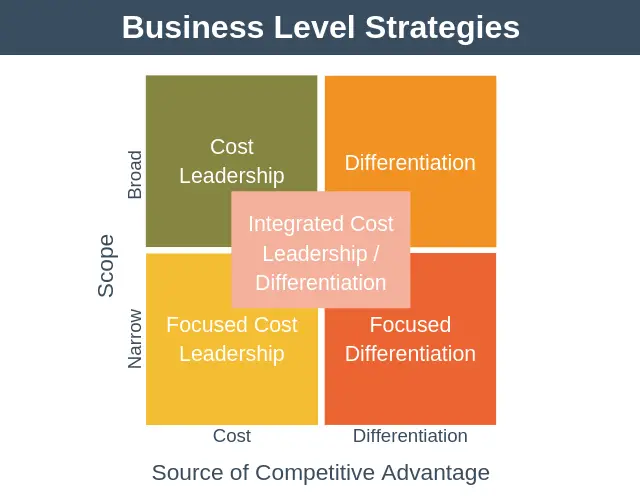
Note that no one generic strategy is better than some other. An organization tin can be successful using any strategy. You need to choose the right strategy for your organization. Choosing the right generic strategy will depend on both what your competitors are doing (the external environment) and likewise where your strengths lie (your cadre competencies).
Business organisation-Level Strategy vs. Corporate-Level Strategy
You can think of Corporate-Level Strategies as happening at a higher level than Business concern-Level Strategies.
Business-Level Strategies concern how an organization should compete, whereas Corporate-Level Strategies concern in what businesses an organization should compete.
Some other manner to say this is that business-level strategy looks at how to win within a market, and corporate level strategy looks at what markets you should be in. For case, you might exist in the vitamin niche. Your corporate-level strategies will determine what niches within the vitamin market you'll compete in, for example, cod liver oil, muscle growth, etc. Your business-level strategy will determine how you intend to win in each of these markets.
Let's examine each of the v generic business concern-level strategies in plough.
one. Toll Leadership Strategy
This strategy is for organizations that want to compete for a broad customer base of operations based on toll.
A misconception well-nigh this strategy is that returns are lower. That is non the instance. To maintain above-average returns and provide the everyman cost, the system must focus on internal efficiencies continually.
Common mechanisms to drive downwardly costs include:
- Establishing rigid toll controls.
- Building state-of-the-art facilities to produce at calibration at a low toll.
To exist effective, this strategy requires your production or service to be standardized.
Defensive Properties
Toll leadership tin help defend your business organisation against Porter's 5 forces:
- Rivalry: Cost leadership means you lot can however make a turn a profit fifty-fifty after your competitors have competed away their profit.
- Suppliers: Cost leaders tin absorb bigger cost increases before those costs need to be passed on.
- Buyers: In a competitive market, powerful customers can force you to sell products at a lower and lower price. However, this tin can force your competitors to exit the market. If this happens, then your customers lose their ownership power, and you lot finish upward in a monopoly position.
- New entrants: By operating at scale and with a continuous focus on cost reduction, you create a bulwark to new entrants.
- Substitutes: By selling at the everyman cost you can build loyal customers.
Price Leadership Example
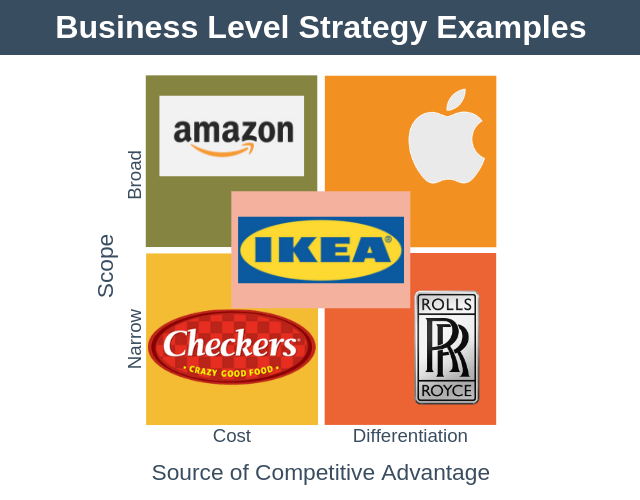
Amazon is an instance of a business using a toll leadership strategy.
It focuses on alluring a big number of customers. It keeps prices low by using its vast buying power to buy products cheaply. This is then combined with no physical stores and state of the art distribution facilities to pass these savings on to consumers but still proceed margins high.
Risks
- By being so focused on cost reduction, you can overlook what your customers actually want.
- Rivals may successfully copy your approach.
- New technology tin upshot in price reductions that eliminate your competitive reward overnight.
2. Differentiation Strategy
This strategy is for firms that desire a wide client base based on their uniqueness. Typically, firms with this strategy will focus on building unique features to win in the market place. They too commonly charge a college toll to their customers, to offset the cost of beingness unique.
Common mechanisms to differentiate include:
- Superior quality.
- Customer service.
- Design.
- Uniqueness.
Defensive Properties
Differentiation tin can assistance defend your business organization confronting Porter'due south 5 forces:
- Rivalry: Brand loyalty and uniqueness tin can prevent competitors from taking your market share.
- Suppliers: Your higher price means you lot are better able to absorb toll increases.
- Buyers: Powerful buyers take limited scope to force price reductions because they can't get what y'all offering elsewhere.
- New entrants: Brand loyalty and uniqueness stops customers from switching to new entrants.
- Substitutes: Brand loyalty and uniqueness prevents customers from switching to alternatives.
Differentiation Strategy Case
Apple is an example of a firm operating a differentiation strategy to sell its laptops to a broad market place. Their unique design and technology allow them to stand out in the marketplace.
This enables them not simply to charge a premium toll but also to combat competitors.
Risks
- Your customers might determine that your uniqueness isn't worth your higher price.
- Competitors could imitate some of your unique features, causing you to lose some of your uniqueness.
3. Focused Cost Leadership Strategy
These organizations compete on price but also stand out because they focus on serving a niche market.
Common mechanisms to adopt a focused toll leadership strategy include:
- Focusing on serving a small group of customers.
- By understanding the needs of your smaller target marketplace, yous tin uniquely cut costs to serve the needs of that market.
Defensive Properties
Focused cost leadership tin can help defend your business against Porter'south five forces in the same style that wide cost leadership can.
Focused Cost Leadership Example
Checkers is a US-based fast-food company that operates on a drive-in only basis. It saves money versus its competitors because it doesn't offering customers anywhere to sit down, and its buildings are cheaper to construct. Checkers targets the cheaper finish of the market. However, despite this, Checkers can withal achieve high-margins because information technology has lower overheads.
Risks
- Your niche might be targeted by broad market firms with more significant economies of calibration.
- Your competitors might subdivide your niche into smaller niches.
4. Focused Differentiation Strategy
This strategy is very similar to that of a differentiation strategy except that it is focused on a very narrow segment of the market. These firms compete by offering unique features to a pocket-sized market segment.
Common mechanisms to focus include:
- Select a profitable narrow subset of the market.
- Focus on areas where contest is weakest.
- Focus on a segment where production substitution is difficult.
Defensive Properties
Businesses using a focused differentiation strategy can defend themselves confronting Porter's 5 Forces in the same way equally businesses using a broad differentiation strategy.
Focused Differentiation Case
Rolls Royce cars is an case of a visitor using a focused differentiation strategy. Their cars are synonymous with prestige, quality, and engineering excellence. They are premium priced and focussed on a tiny subset of the global motorcar market.
Risks
- Your niche might be targeted by wide market place firms with bigger economies of scale.
- Your competitors might subdivide your niche into smaller niches.
5. Integrated Cost Leadership/Differentiation Strategy
This strategy involves producing low-toll products with differentiated features. This strategy is near simultaneously focusing on 2 drivers of competitive advantage: cost and differentiation. This type of strategy is oftentimes called a hybrid strategy.
To empathise the appeal of a hybrid strategy, realize that a mid-priced product that distinguishes itself in some mode can exist more appealing to customers than a inexpensive generic product.
This can be a high-risk strategy because you must invest in both reducing costs (through automation, etc.) and also invest in differentiating your production.
Integrated Price Leadership/Differentiation Instance
IKEA is a groovy example of a business with an integrated toll leadership and differentiation strategy. It sells unique products that you can't become elsewhere. Information technology invests in its own designers to accomplish this. It also sells information technology's products at a low toll. It invests in automation and logistics to practise this.
A less obvious case of a business using an integrated toll leadership and differentiation strategy is Southwest Airlines.
Southwest Airlines provides price leadership by:
- Just using a single model of shipping (Boeing 737).
- Using cheaper minor airports.
- Not providing meals.
- Having a short 25 minute turnaround fourth dimension.
It provides a level of differentiation by:
- Focusing on client satisfaction.
- Trying to make the experience of flying fun.
Risks
- The firm may find itself "stuck in the center." This is where a firms product isn't cheap enough to compete with competitors and nor is information technology differentiated sufficiently.
- It can be challenging to reduce costs at the same time as increasing differentiation.
Any strategy you choose to adopt, y'all will demand to configure your value chain to support the approach chosen.
In the diagram below you tin can run across all our examples mapped to the previous diagram.
Summary
Business organisation-Level Strategy theory states that there are essentially iii strategies you as an organization can use to win in the marketplace: cost leadership, focus, or differentiation.
Which i y'all choose with depend on market conditions and your unique gear up of core competencies.
Toll leadership aims to increase market place share past focusing on producing at low cost. Focus looks to dominate a small market segment past exclusively focusing on serving that segment (y'all can always add new segments later). Finally, differentiation aims to grow market share by concentrating my making your product or service dissimilar and unique.
Source: https://expertprogrammanagement.com/2019/09/business-level-strategy-explained/
0 Response to "What Business-level Strategy Does Southwest Seem to Be Pursuing? Why?"
Post a Comment